
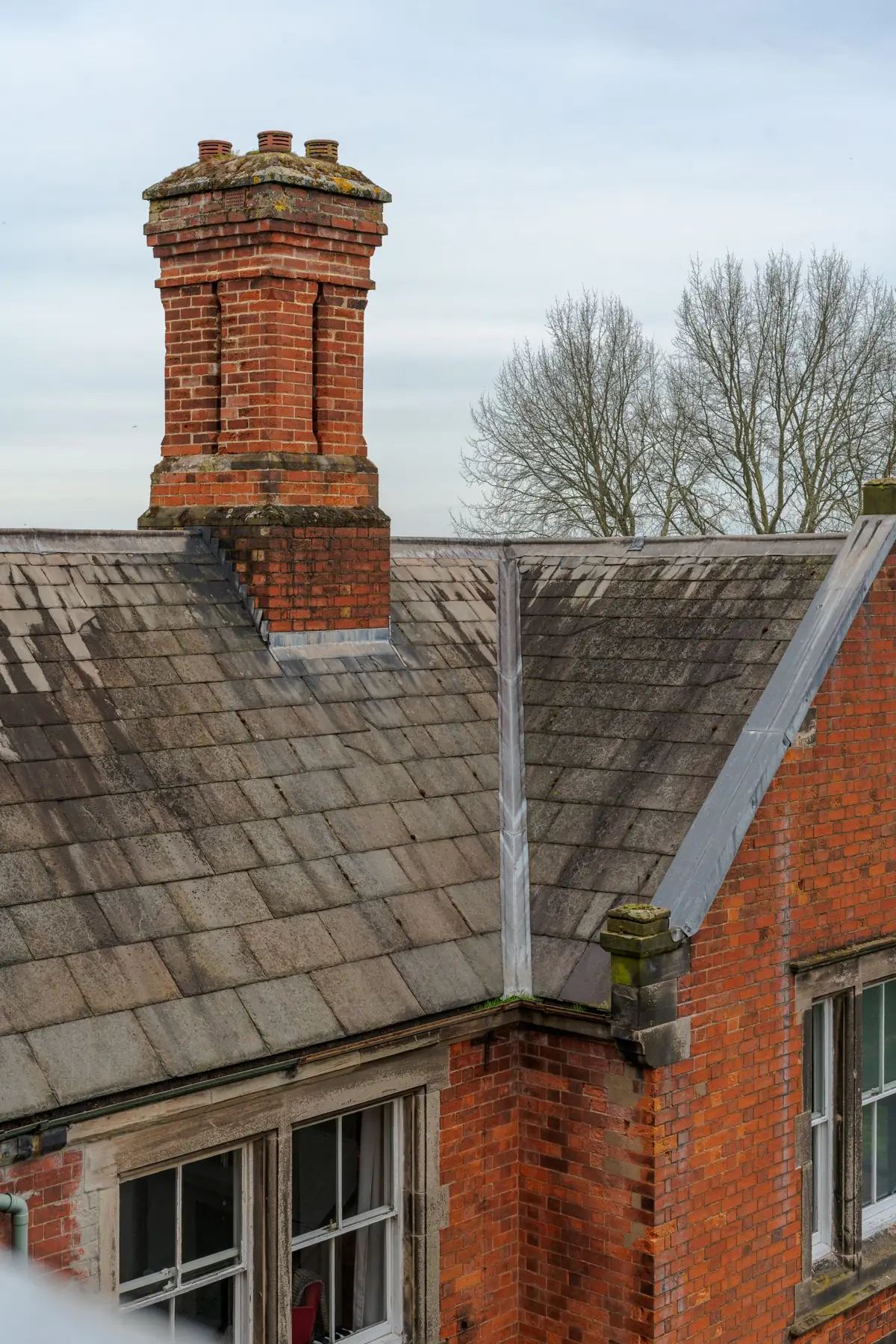
Chimney Leaks Traced to the Source, Then Fixed
Almost all chimney leaks start at one of four spots: the crown, the flashing, an open flue or the brick itself. The leak check is free, and typical fixes run $150 to $1,500 once we know the source.
Rain and melted snow add up to about 51 inches a year at the Franklin Institute weather station in Center City, and most of SE Pennsylvania lands between 42 and 52 inches in NOAA's 1991–2020 normals. A chimney stands in all of it, poking up through the roof with seams on every side. When a brown ring shows on the ceiling by the chimney breast, or the plaster beside the fireplace starts to bubble, the water has almost always found one of a few openings at the top of the house.
The tricky part is that the wet spot indoors rarely sits right under the opening. Water runs along rafters, down the outside of the flue tile and through the inner brick before it shows. Painting over the stain, or smearing roof tar around the base, treats the symptom. We go up, find where the water actually gets in, show you photos, and price the fix for that spot.
When to call
- A brown ring on the ceiling or wall beside the chimney
- Water or rust in the firebox, or a rusted damper
- Peeling paint or bubbling plaster on the chimney breast
- Water at the base of a furnace or water heater flue
- A musty smell from the fireplace after rain
- Damp boards or rafters around the chimney in the attic
The visit, step by step
- Check all four entry pointsThe free leak check covers the crown, the flashing on every side, each flue opening and cap, and the brick and joints, with photos of each.
- Match the stain to the sourceWe compare where water shows indoors with what we found on the roof, and in the attic when we can reach it, so the repair hits the real opening.
- Repair the opening, not the stainCrown cracks get sealed, flashing gets reset or replaced, an open flue gets a cap, and open joints get repointed in a mortar suited to the brick.
- Watch the next soaking rainTell us what you see after the next heavy storm. A dry ceiling confirms the source; a new damp spot points us to the next one.
Where the water usually gets in
The Historical Commission's Diamond Street manual puts it plainly: water problems at chimneys start at the flashing and at the top. That holds for a Fishtown rowhouse and a Bucks County colonial alike. The four usual entry points:
- The crown, the concrete or mortar top around the flue tile. The 2021 IRC (R1003.9.1) wants a pitched top with an overhanging drip and a flexible joint at the flue; many older crowns are a thin mortar wash with neither, and they crack.
- The flashing, the metal where the roof meets the brick. Sealant dries out, counter-flashing pulls out of its joint, and on a chimney wider than 30 inches the code (R1003.20) wants a cricket to split water on the uphill side.
- The open flue. Without a cap, rain falls straight down the tile onto the damper and smoke shelf.
- The brick and joints. Open mortar joints and spalled brick faces soak up water that wicks inward.
Why a small leak gets worse each winter
NOAA logs about 62 nights a year at 32°F or colder in Center City, where the built-up city holds its warmth. Norristown averages about 107, Lancaster 109, Reading 106 and West Chester about 131. Water that seeps into a hairline crack in a crown or a joint freezes and expands on each of those nights, so a slow seep in November can be a steady drip by March. That is why fall is the right time to fix it.
Roof tar is the tempting shortcut. The Diamond Street manual advises against covering masonry chimneys in tar, cement or stucco, and the reasoning holds anywhere: the coating traps moisture inside the brick, and the freezing then happens behind it.
Roofer or chimney company?
A roofer is the right call when the shingles or the roof membrane around the chimney have failed. When the crown, the mortar joints, the cap or the counter-flashing set into the brick is the problem, the work is masonry, and that is ours. On a rowhouse the stack may be shared with the house next door. No city rule says who handles a shared stack; it depends on which flue serves which house and on your deeds, so we photograph and document both sides before any repair.
What a leak repair typically costs
Sealing cracks in an otherwise sound crown typically runs $150 to $550 in 2026. Flashing repair is usually $300 to $1,500, depending on the roof, the size of the chimney and whether the counter-flashing has to be cut back into the joints. A breathable water repellent for brick that is soaking up water through its faces typically costs $150 to $820. Many leaks need only one of the three. The leak check is free, and the price for the fix is written down before we start.
Answers
Chimney Leak Repair questions
My chimney drips only during downpours. Why?
Light rain soaks into the brick and dries out again. A hard, wind-driven storm overwhelms a cracked crown, lifts water past worn flashing or drives it through open joints. Leaks that show only in big storms usually point to the crown or flashing on the side facing the wind.
How do you find where the water is coming in?
We check the crown, flashing, flue openings and masonry from the roof, look at the attic side when we can reach it, and compare that with where the stain shows indoors. Each suspect spot gets photographed so you can see what we saw.
Should I hire a roofer to fix a chimney leak?
Only when the roofing around the chimney has failed. Cracked crowns, open joints, missing caps and counter-flashing set into the brick are masonry problems, and patching them with roof tar usually traps water rather than stopping it.
Is it the flashing, or does the chimney need waterproofing?
Flashing and crowns cause more leaks than brick faces do, so we rule them out first. Water repellent helps when the brick itself is absorbing water, and only after the openings are closed.
Can I use my fireplace if the chimney is cracked and leaking?
A wet chimney is not always unsafe that day, but a leak that has cracked flue tile or rusted the damper can be. Hold off on fires until the free inspection tells you whether the flue is still sound.
Same family of jobs
Brick, stone, water and rebuilding

Schedule
Choose a morning or an afternoon.
Sunday through Friday, arrival between 8 and 11, 11 and 2, or 2 and 5. The look costs nothing, and a person phones you the day before.