
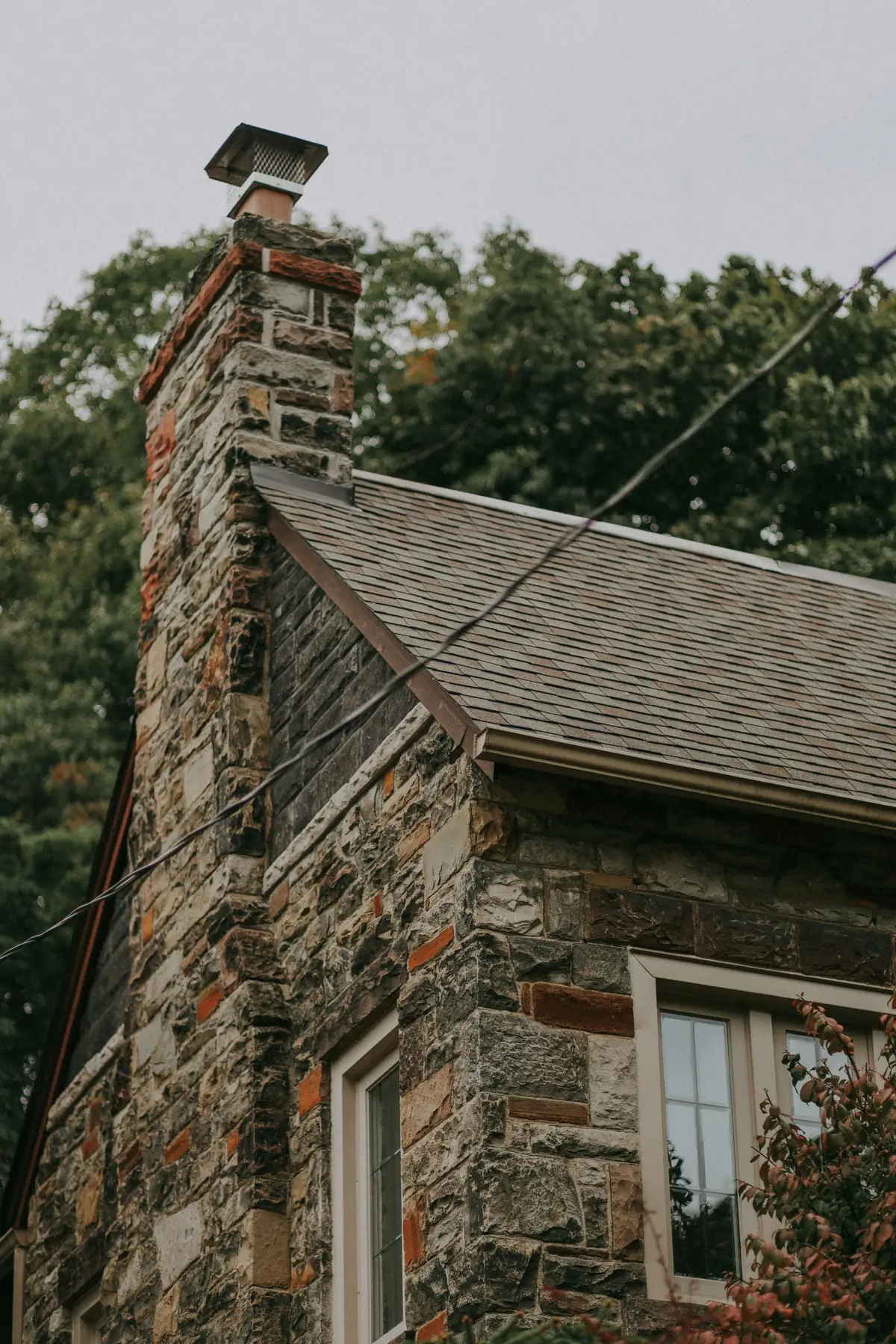
Repointing Stone and Serpentine Chimneys
Old stone chimneys fail at the joints first, and the wrong mortar speeds it up. We repoint with a lime-rich mix softer than the stone. Repointing typically runs $500 to $2,500, and replacing failed stone or spalled brick $1,000 to $3,500.
Chester County is the coldest corner of our map. NOAA's 1991 to 2020 normals put about 131 nights a year at or below freezing at the station near West Chester and about 120 near Coatesville, against about 62 in Center City, with 30 to 32 inches of snow a year at both suburban stations. Stone chimneys on old farmhouses and borough houses there take that beating every winter, and the joints are where it shows first.
Bucks County has its own stock of stone houses from the 1700s and 1800s, and the Main Line and Montgomery County mix stone with brick. Some of that stone is ordinary fieldstone; some is the green serpentine once quarried around West Chester. All of it shares one weakness: mortar harder than the stone. Gray, Portland-heavy patches from past repairs hold water in and push the damage into the stone itself.
When to call
- Joints recessed, sandy or hollow when tapped
- Hard gray patches over older, softer mortar
- Green serpentine flaking, splitting or crumbling
- Stones loose or shifting near the top of the stack
- Water stains inside where the chimney meets the roof
The visit, step by step
- Free inspectionWe look at the stone, the old mortar and earlier patches, and photograph the worst joints.
- Match the mortarWe check the existing mortar's color, sand and hardness and choose a softer, lime-rich mix.
- Rake out by handOld mortar comes out with hand tools to sound material, without chipping the stone edges.
- Repoint and cureNew mortar goes in layers, tooled to match, and is kept damp while it cures in mild weather.
Why soft mortar matters on stone
The National Park Service's Preservation Brief 2, Repointing Mortar Joints in Historic Masonry Buildings, leaves no doubt: the new joint has to let moisture out more easily than the bricks or stones, and it may not be any harder than the lime mortar that was there before. A mortar stronger than the stone will not give as the wall moves with heat and frost, and the stone cracks or spalls instead. The Brief also says masonry cements generally are not recommended for historic masonry.
Traditional mortar was mostly lime and sand, about 1 part lime putty to 3 parts sand, the Brief notes, and portland cement was not in common use in the United States until the early twentieth century. Lime mortar is soft and porous and changes little in volume with temperature. That is what lets water leave through the joints instead of through the stone.
Serpentine, the green stone of Chester County
Serpentine was used for facades and trim in Philadelphia and in rural areas near the quarries such as Chester County, says the National Park Service's technical note on replacing serpentine. The same note explains its weakness: it is not tightly consolidated but fibrous, and it absorbs water, which speeds its breakdown through freeze and thaw. It is also sensitive to acid and is no longer quarried as an exterior building stone.
Westtown Township's newsletter tells the local side of the story. Brinton's Quarry, on Serpentine Ridge in Westtown, produced some 500,000 cubic yards of stone between 1870 and 1888, and an 1887 fire flooded the pit. You can still see serpentine on the West Chester University campus and along New Street, and West Chester's HARB guidelines point to it at Horticultural Hall on North High Street.
For a serpentine chimney that means gentle handling: no acid cleaners, no hard mortar, and repairs that keep water moving out of the stone rather than trapped in it. Because new serpentine is not quarried for building, failed stones are a matter for the inspection, where we talk through what replacement material makes sense and price it.
The West Chester HARB mix, and other boroughs
West Chester's HARB design guidelines ask that new pointing match the color, texture and tooling of the original and not have a high Portland cement content. They give a recommended mix for historic chimney brick of 1 part white Portland, 1 part hydrated lime and 5 parts sand, and a softer 1 to 2 to 6 for historic wall brick. If your chimney is in the borough's historic district, that is the starting point for the review.
Elsewhere, the mix should follow the masonry in front of us. Columbia borough in Lancaster County pre-approves repointing done to Preservation Brief 2. In other places we check what your borough or township requires before any work starts.
- Softer than the stone or brick, and no harder than the old mortar
- Lime-rich, matched to the original color and sand
- Raked out by hand, never ground wider
- No masonry cement, no acid cleaners on serpentine
- Cured in weather that stays above freezing
What we won't assume about your stone chimney
Stone chimneys in Bucks and Chester counties were built many ways over two centuries, and plenty have been rebuilt or relined since. We do not assume yours is lined or unlined, or what its mortar contains, until we have looked. The inspection checks the flue as well as the outside, because current code calls for masonry chimneys to be lined and for the lining to suit the appliance connected to it.
Repointing a stone stack typically runs $500 to $2,500. Failed stone or spalled brick usually costs $1,000 to $3,500 to replace. Mortar needs mild weather to cure, so outside the warmer months we schedule around a forecast that stays above freezing; one Historical Commission manual asks for 45°F or above for 72 hours.
Answers
Stone & Serpentine Chimney Repointing questions
What mortar should go on an old stone or soft brick chimney?
One softer than the stone or brick and no harder than the original mortar, as NPS Preservation Brief 2 says. In practice that is a lime-rich mix matched to the old mortar's color and sand. Masonry cement and straight Portland are wrong for it.
Why are serpentine buildings in West Chester crumbling?
Serpentine is fibrous and absorbs water, so freeze-thaw breaks it down, and it is sensitive to acid. The National Park Service's technical note on serpentine describes exactly that. Hard mortar and acid cleaners make it worse.
What's the difference between tuckpointing and repointing?
Repointing means raking out failing mortar and filling the joints with new. Tuckpointing, strictly, is a decorative finish with a thin contrasting line of mortar, though many people use the word for any repointing. A weathered stone chimney needs repointing.
Can I still buy serpentine for repairs?
Not as newly quarried building stone; the National Park Service notes it is no longer quarried for exterior use. Replacement options are discussed and priced at the inspection.
How much does stone chimney repointing cost?
Repointing typically runs $500 to $2,500. Failed stone or spalled brick usually costs $1,000 to $3,500 to replace. Looking is free, and any price is on paper before work.
Can repointing be done in winter?
Mortar has to stay above freezing while it cures. One Historical Commission manual asks for 45°F or above for 72 hours. We schedule around the forecast and will not point into a freeze.
Same family of jobs
Brick, stone, water and rebuilding

Schedule
Choose a morning or an afternoon.
Sunday through Friday, arrival between 8 and 11, 11 and 2, or 2 and 5. The look costs nothing, and a person phones you the day before.