
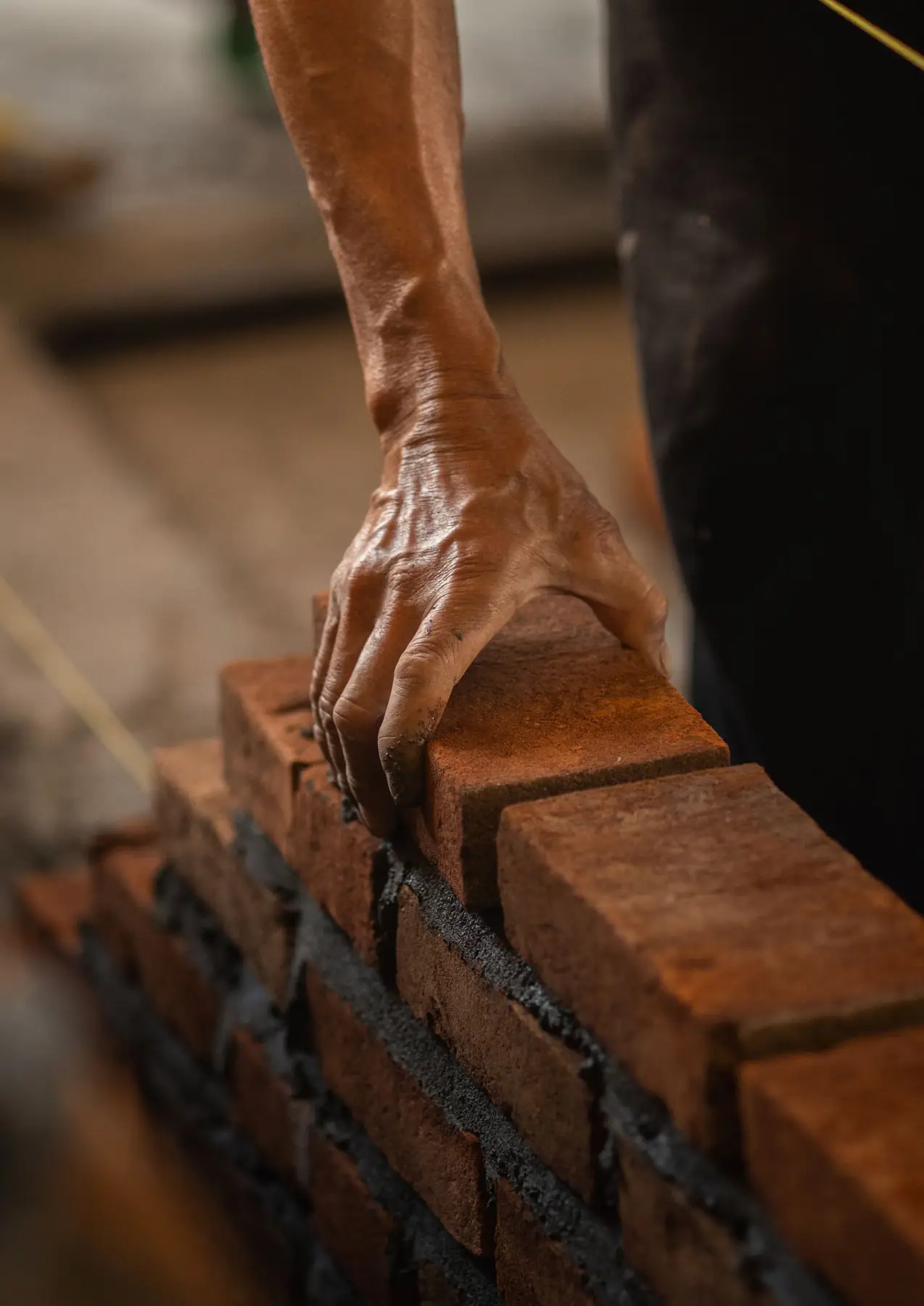
Repointing Brick Chimneys With Mortar the Brick Can Live With
Repointing a chimney typically costs $500 to $2,500. Where yours falls depends on how deep the joints have worn and how hard the stack is to reach, and we write the price down at the free inspection.
Mortar is meant to be the sacrificial part of a chimney. It is softer than the brick, it takes the water and frost, and every few decades it gets raked out and replaced. A chimney stands above the roof with weather on all four sides, so its joints wear out long before the walls below. On a Philadelphia rowhouse that can mean a stack catching wind across a whole block of roofs.
The City's Philadelphia Rowhouse Manual adds a local catch. Many nineteenth-century rowhouses were laid with very thin mortar joints, which it calls butter joints, and the manual says the old mortar must be removed by hand, not sawn out into a wider joint. It also says new mortar should have properties similar to the brick. A fast job with a grinder and gray cement does the opposite on both counts.
When to call
- Mortar recessed more than a quarter inch, or sandy to the touch
- Gaps you could slide a key into
- Brick faces flaking next to hard, gray patches
- Water stains in the attic or top floor beside the chimney
- Loose bricks in the top few courses
The visit, step by step
- Free inspectionWe check every face of the stack, how deep the joints have worn and what earlier repairs used.
- Mortar matchWe pick a mix softer than the brick, matched in color and texture to the original.
- Rake outOld mortar comes out to a sound depth, by hand where the joints are thin.
- Repoint and toolNew mortar is packed in layers and tooled to match the old joints.
Why the mortar has to be softer than the brick
Most preservation boards lean on the Park Service's Brief 2 for this. Its point: a new joint should be weaker and more breathable than the brick, and never harder than what the builders first used. A stronger mortar does not give as the wall moves with heat and frost, so the brick takes the stress and cracks or spalls. The Brief does not recommend masonry cements for historic masonry.
Philadelphia brick raises the stakes. The Rowhouse Manual notes that its hard outer face protects a much softer interior. Once that face pops off, water goes straight into the soft core, and the next winter takes more.
How deep, and when
The Historical Commission's Diamond Street manual, written for one district but useful anywhere, puts the rake-out depth at about two and a half times the joint height, which for brick works out to roughly half to three quarters of an inch. It asks that pointing be done only when the temperature will stay at 45°F or above for 72 hours. Fresh mortar that freezes fails.
That gives the work a season. Spring through fall is ideal, and in mild winter spells we watch the forecast rather than point into a freeze. Outside the city the limit bites harder: NOAA counts about 107 freezing nights a year at Norristown and about 131 near West Chester.
Permits and historic properties
In Philadelphia, L&I says pointing masonry often needs no permit as long as the property is not on the historic register. If it is, the Historical Commission treats pointing as an alteration, and staff usually review a pointing sample in the field before the job goes ahead. Our historic district page walks through that process.
Outside the city, we check what your township or borough requires. A few historic boroughs, West Chester and Doylestown among them, have review boards of their own.
Answers
Chimney Repointing questions
What's the difference between tuckpointing and repointing?
People use both words for the same job: raking out old mortar and filling the joints with new. Strictly, tuckpointing is a decorative finish with a thin contrasting line. What a weathered chimney needs is repointing.
Do I need a permit to repoint my house in Philadelphia?
Often not, according to L&I, as long as the property is not on the historic register. If it is, the Historical Commission reviews pointing as an alteration first.
What mortar should I use on old soft brick?
A lime-rich mortar softer than the brick, matched to the original. Preservation Brief 2 explains why hard Portland mixes and masonry cements damage old brick.
How long does repointing last?
Done right, decades. Joints at the top of a chimney wear faster than the walls below because they take weather from every side, and a cracked crown or missing cap shortens their life.
How much does chimney repointing cost?
Typically $500 to $2,500 for the stack. Deep erosion, tall stacks and steep slate roofs push it toward the top of that range. Spalled brick replacement is a separate item.
Same family of jobs
Brick, stone, water and rebuilding

Schedule
Choose a morning or an afternoon.
Sunday through Friday, arrival between 8 and 11, 11 and 2, or 2 and 5. The look costs nothing, and a person phones you the day before.